- Oral motor is what the mouth can physically do.
- Oral sensory is how your child feels and reacts to what is in their mouth.
- A child can have one, the other, or both at once.
- Babies start bringing toys to their mouth around three to four months, and that play prepares them for solids.
- The gag reflex begins to shift further back towards the middle/back of the tongue and throat around 4-6 months.
- Chewing on everything is normal during teething. A habit that lingers and gets in the way of daily life deserves a closer look.
- More than 1 in 37 US children under five receive a pediatric feeding disorder diagnosis each year.
Oral motor skills refer to what your child's mouth can physically do: moving the tongue, closing the lips, chewing, and swallowing. Oral sensory skills include how your child experiences texture, temperature, taste, and touch in the mouth.
The two often overlap. That is why I look at both in every feeding evaluation.
I'm a pediatric occupational therapist, and I work with babies from a few weeks old through about age four. I'm also a mom, and my own son is the reason I do what I do.
My son could not breastfeed, but he took a bottle right away. I experienced several professionals tell me breastfeeding just hurts at first and that we would both figure it out.
Weeks turned into months, and I knew something was still not connecting. It turned out he had a medial tongue tie, which used to be called a posterior tie and is harder to spot. We addressed it when he was a toddler.
That experience changed how I treat. I learned to look for the root cause, and I learned what it feels like to be the tired parent on the other side of the evaluation.
Oral Motor vs Oral Sensory: What Is the Difference?
Oral motor skills are the physical movements of feeding. I look at:
- how the tongue moves
- whether the lips close
- how strong and coordinated the suck is
- how the child chews and swallows
Oral sensory processing is how your child takes in that input and reacts to it. Here I watch how a child responds to the texture of a food, its temperature, its taste, and touch in and around the mouth.
Let's compare the two side by side.
| Oral motor | Oral sensory | |
|---|---|---|
| What it means | What the mouth can physically do | How the mouth feels and reacts to input |
| What I look at | Tongue movement, lip closure, suck strength, chewing, swallowing | Reactions to texture, temperature, taste, and touch |
| What it can look like in a baby | Poor latch, weak suck, poor coordination, working very hard to move the tongue | A hard time managing the feel of the nipple in the mouth |
| What it can look like in a toddler | Reverse swallow or tongue thrust, frequent coughing, trouble chewing tougher foods | Refusing certain textures, needing a food to look the same every time |
| Overstuffing the mouth | May need that much food to coordinate a chew and swallow | May need that much sensation to know where the food is |
That last row is my favorite example. Two toddlers can stuff their cheeks the same way for completely different reasons, and the reason decides what helps.
Can a Child Have Both Oral Motor and Oral Sensory Issues?
Yes. A child can have only an oral motor deficit, only an oral sensory deficit, or both.
When both are present, they feed into each other. A baby who struggles to move food around the mouth may start avoiding textures. A toddler who avoids textures misses the practice that builds chewing strength.
This is why I don't treat a feeding problem as one thing. I peel it back layer by layer until I find what is driving it.
What Happens in a Feeding Evaluation
Every child I see starts with a full functional evaluation. Here is what that covers.
Birth History
I ask how your baby was born, vaginally or by C-section. I also ask whether any birth assistance was used, like vacuum or forceps.
Prematurity
I note the week your baby was born. A baby born before 37 weeks is considered premature, and that can be one piece of the feeding puzzle.
Babies keep practicing feeding skills in the womb. A premature baby may miss some of that practice, so a poor latch, weak suck, or poor coordination can be expected if born prematurely.
Research on preterm feeding shows that sucking, swallowing, and breathing mature at different times and rates. A baby has to coordinate all three at once, and that is hard when one system is still catching up.
Even full-term babies spend their first few weeks fine-tuning these skills.
Current Feeding
I watch how breast and/or bottle feeding is going right now. With bottles, I look at positioning and nipple flow, because both change how hard your baby has to work.
Oral Reflexes and the Whole Baby
With a young infant, I trigger oral reflexes to see the motor response. I stimulate the tongue, lips, and palate, checking suck strength and coordination, and note which reflexes are present or already integrated.
Occupational therapy looks at the whole child. I also assess cognitive skills, adaptive behavior skills, and social-emotional skills.
Parent Education From the Start
I explain what I see while I see it. If I'm testing a reflex, I'll say that I'm looking for the tongue to follow my finger.
If your baby is trying hard but arching their back, I'll point that out too. It tells me your baby is compensating somewhere.
"Before I became a parent, I handed families long lists and overwhelming home programs. Now I give one or two things to focus on at a time. Therapy should feel achievable, and it should never add pressure to a family that is already stretched."
Jill Justiniani, MS, OTR/L
A Food Diary for Toddlers
For children eating solids, I ask families for a food diary. It shows me what your child is offered, what they accept, and which textures or food groups are missing from their diet. This gives me great insight into your child's oral motor and oral sensory development as I begin to piece the puzzle together.
Oral Motor Skills by Age
Feeding skills develop in stages. Here is what I look for at each one.
Newborns and Young Babies
Babies suck in the womb. It is a natural, healthy activity, and I want to encourage it.
That is also why I don't panic about a pacifier. For many families, it is a real regulation tool. What matters is using it thoughtfully and having a weaning plan when your baby and your family are ready.
At this age, my assessment is about reflexes, suck strength, and coordination. The tongue protrusion reflex is present at birth and typically fades by about six months.
Three to Six Months: Mouthing and Oral Play
Around three to four months, babies start bringing toys to their mouth. This oral play teaches them how different things feel inside the mouth.
I encourage it early, well ahead of first foods. It is how the mouth prepares for solids.
Starting Solids: What Gagging Tells You
When babies start solids, gagging is part of learning. The gag sits forward on the tongue in early infancy.
Around four to six months, the gag reflex begins to shift further back towards the middle/back portion of the tongue and throat and diminishes around six to seven months, which lets babies explore food without gagging so much.
If gagging stays intense well past that window, I want to look at why.
Toddlers: Chewing and Swallowing
In toddlers, the assessment moves to the table. I watch what foods your child can safely chew, how they chew them, and whether the swallow looks mature.
Here is what catches my attention:
- A reverse swallow or tongue thrust coming through
- Frequent coughing while eating
- Overstuffing the mouth
- A diet limited to soft or easy textures
Oral Mapping: Getting the Mouth Ready for Food
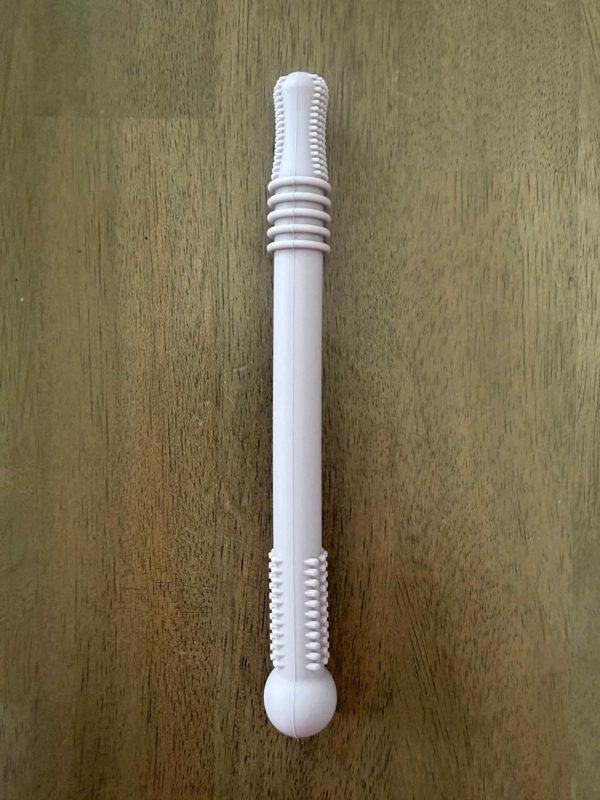
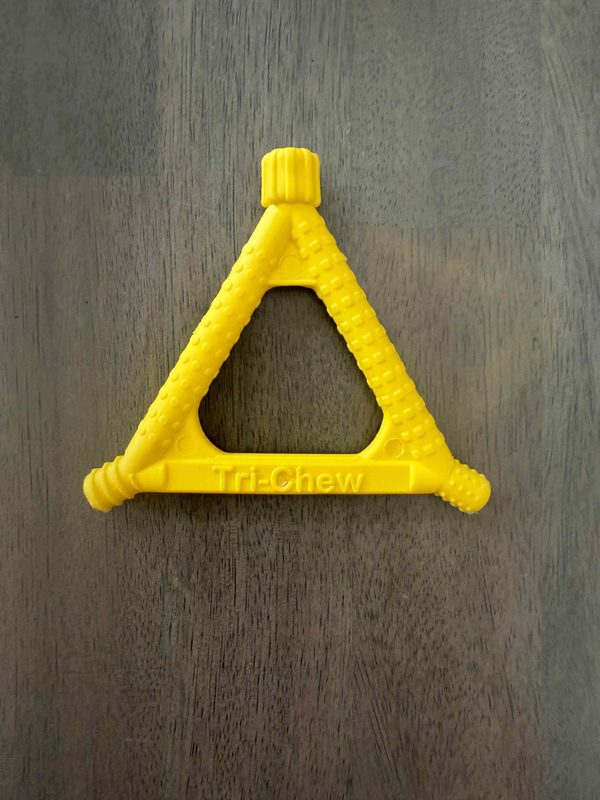
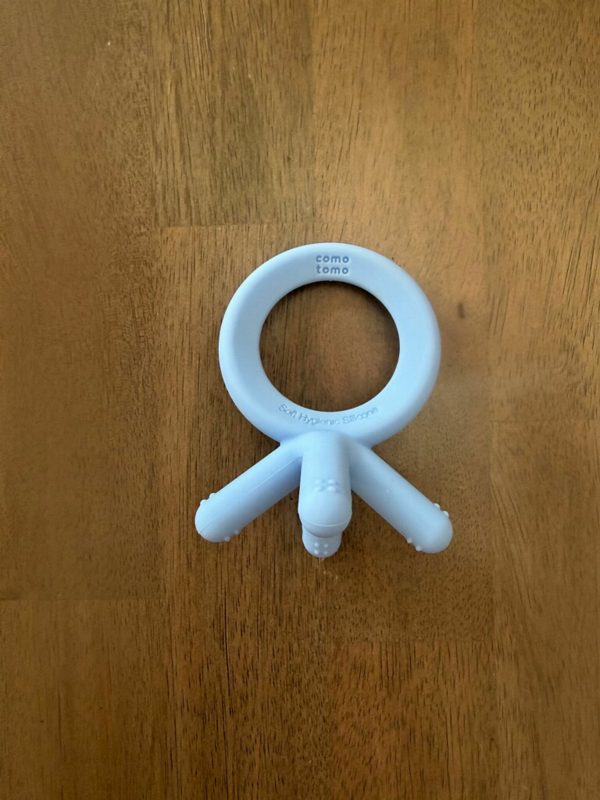
Oral mapping is when a baby uses a teether or a chewy tube to explore the inside of the mouth. It stimulates the tongue and jaw muscles and builds early oral motor skills.
I recommend stick-shaped teethers. A baby can place a teether stick on the molar surface, which triggers the phasic bite reflex and starts the munching pattern that chewing grows from.
The phasic bite reflex emerges before birth and fades by one year of age. Those first months are a great time to give it something to work with.
The sensory experience lays out a map for the motor skill. By the time food arrives, your baby already has some idea of how to manage it.
Stick teethers also provide comfort during teething, so one tool covers both jobs.
Why Chewing Tougher Foods Matters
Many families lean on soft foods because they are afraid of choking. I understand that fear, and supervision always matters.
A child who rarely chews harder textures misses practice, though. That can affect jaw strength, coordination, and endurance at the table.
When the food diary shows a narrow range of textures, I help families introduce new textures step by step. We start where the child is and build from there.
Toddler Chewing on Everything: Normal or a Red Flag?
Chewing on everything is often normal. Teething drives chewing, and babies explore the world with their mouths while they learn how it works.
I take a closer look when the habit lingers past those developmental phases. Chewing on burp cloths, sleeves, or all kinds of daily items can be a sign of oral sensory seeking.
When I see that, I ask three questions:
- Is there a pattern in the items your child reaches for?
- Does your child seem to benefit from the chewing input, like calming down or focusing?
- Is it affecting function, like eating, playing or daily routines?
Those answers tell me whether this is a phase or something to support.
Why Some Kids Refuse a Food That Looks Slightly Different
Some children accept a food only when it looks exactly the same every time.
One child I worked with ate regular Goldfish crackers easily. When we offered the multicolored Goldfish in nearly identical packaging, the child refused them.
The cracker was the same. The color change was enough to make it feel unsafe and unpredictable.
For these kids, the work is mental flexibility and comfort with change. We explore foods in a safe, playful way, because children learn through play.
Over time, repeated positive experiences help the brain relearn that a new food can be safe.
When to Get a Feeding Evaluation
Many parents bring up feeding concerns and hear "give it time." Some pediatricians look closely at root causes, and others don't have the time or training in this niche.
If your gut says something is off, trust it. More than 1 in 37 American children under five receive a pediatric feeding disorder diagnosis each year, according to a nationwide study in The Journal of Pediatrics.
Red flags
- Breastfeeding is still painful after the early weeks
- Your baby chomps at the breast
- Feeds regularly take over 30 minutes
- You feel like you are constantly feeding your baby
- A poor latch or weak suck that is not improving
- Frequent coughing or overstuffing during meals
- A very limited diet or strong refusal of textures
- Chewing on non-food items that lingers past teething and affects daily life
Referrals to me often come from airway-focused dentists and pediatricians. Sometimes a dentist identifies oral ties and sends a baby for therapy ahead of a tie release, because that support leads to better outcomes afterward.
"Breastfeeding should not be painful, and a baby who takes a bottle can still have feeding challenges. If you feel like something is not connecting, that feeling deserves an evaluation."
Jill Justiniani, MS, OTR/L
Sources
- Barlow SM. Oral and respiratory control for preterm feeding. Current Opinion in Otolaryngology & Head and Neck Surgery, 2009.
- Kovacic K, et al. Pediatric Feeding Disorder: A Nationwide Prevalence Study. The Journal of Pediatrics, 2020.
- Physiology, Gag Reflex. StatPearls, NCBI Bookshelf.
- Infant Swallow Physiology. Swallowing and Its Disorders Across the Lifespan.
FAQ
What is the difference between oral motor and oral sensory?
What are signs of oral sensory seeking in toddlers?
Why does my toddler overstuff their mouth?
When does a baby's gag reflex calm down?
Can premature babies have feeding problems?
What is oral mapping?
Is it normal for my baby to chew on everything?

Dr. Joyce Kahng is a cosmetic dentist, veneer expert, and the founder of Orange + Magnolia Dental Studio in Costa Mesa, CA. With 16+ years in practice and a following of 1.5M+ across Instagram, TikTok, and YouTube, she's known for making dentistry actually make sense. She's been featured in Forbes, Vogue, Allure, Glamour and GQ, and is the creator of the VeneerLIFT™.
Our editorial process · written by a contributing expert, medically reviewed by a dentist, corrected in the open.
- 17 Oct 2026 Published. Clinical review by Dr. Joyce Kahng, DDS.
Is something here out of date?
Evidence moves and pages go stale. If you treat this every week and you’d change something on this one, tell us what and why. A dentist reads every submission.