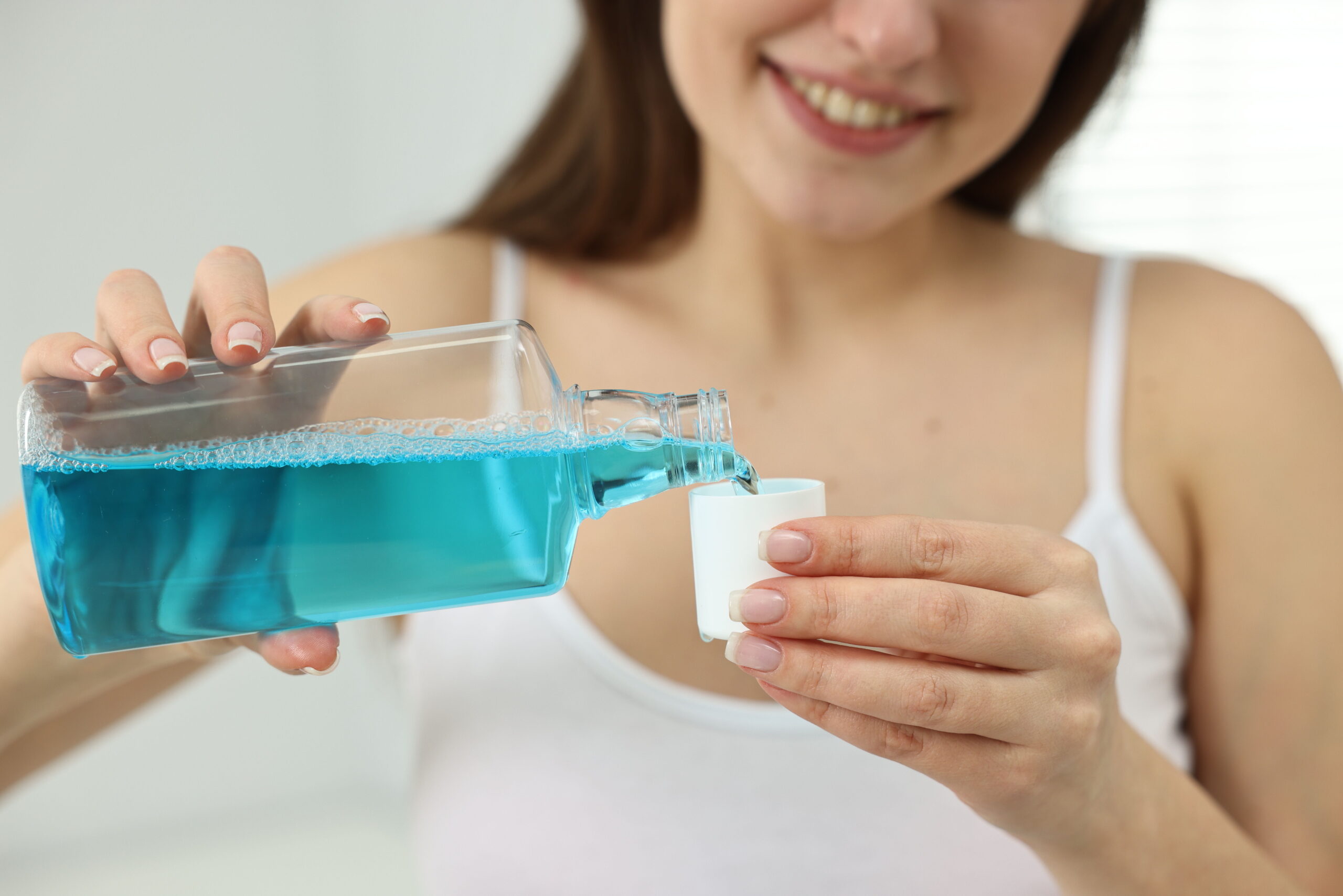
The best mouthwash for gingivitis is alcohol-free, disrupts plaque biofilm without stripping the oral microbiome, and supports a pH environment where inflamed tissue can recover.
I’ve been a dentist for over 16 years. I’ve recommended a lot of products. Some of them I’d take back.
The mouthwash category is where my thinking has changed the most, and if your gums are still bleeding despite doing everything right, this might be why.
What I Got Wrong About Treating Inflamed Gums
When your gums are bleeding, the instinct is to reach for the most powerful thing on the shelf.
I get it. It feels logical. If there’s an infection, you want to kill it.
The problem is that’s NOT how gum health works.
Gingivitis affects nearly 50% of American adults over 30. That’s definitely not a niche problem. And most of those people are reaching for the same category of products I used to recommend without thinking twice.
Aggressive antiseptic rinses, especially high-alcohol formulas, don’t just target bad bacteria. They disrupt the entire bacterial balance in your mouth.
When you wipe out that balance, you remove the natural defenses your tissue relies on to protect itself. The product feels like it’s doing its job. The outcome is a mouth that’s actually worse at defending itself than before you started rinsing.
Alcohol-based mouthwashes have been linked to reduced nitric oxide production in saliva. Nitric oxide plays a real role in gum tissue health and circulation. A 2025 study published in Frontiers in Oral Health found that regular mouthwash use can disrupt the nitrate-reducing bacteria in your mouth and affect systemic nitric oxide levels tied to inflammation.
When you’re rinsing with alcohol twice a day, you’re interfering with a mechanism your body needs.
And then there’s dry mouth.
- Alcohol dries the mouth out.
- A dry mouth is a more acidic mouth.
- A more acidic mouth is where harmful bacteria grow faster.
So the product you’re using to fight inflammation is creating conditions where inflammation thrives. That cycle is really common.
This is a pattern I see across the oral care category. Stronger sounds better, but it rarely is, especially for something you’re using every single day.
You don’t really want to sterilize your mouth. The goal is to support an environment where healthy tissue can do its job.
The Four Things I Check Before Recommending Anything
Mouthwash is an addition to your routine, not a replacement for brushing and flossing. Once you have the basics in place, here’s what I look for in the rinse itself.
Alcohol-free. Non-negotiable for daily use on inflamed tissue. Everything listed above is the reason why.
Biofilm-disrupting, not just antibacterial. Surface bacteria and plaque biofilm are different targets. You want something that penetrates the biofilm structure. CPC (cetylpyridinium chloride) has solid clinical evidence for doing exactly that.
pH-neutral or alkaline. Most commercial rinses acidify the mouth. Pathogenic bacteria thrive in an acidic environment. This is something most brands don’t address, and most patients never hear about.
Formulated to work with saliva rather than against it. Xylitol disrupts bacterial adhesion and supports salivary flow. Calcium supports the remineralization environment.
Recommended reading: Best Hydroxyapatite Toothpaste in 2026: What the Labels Are Not Telling You
What’s in My Bathroom Cabinet
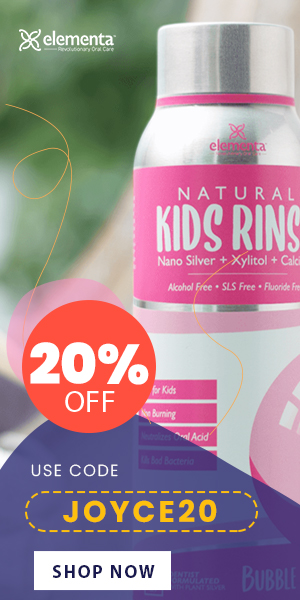
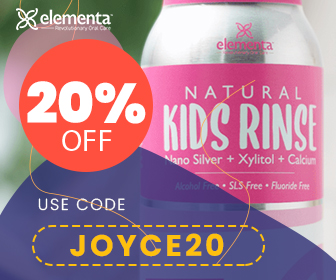
The rinse I use daily is Elementa Silver. I have a discount code, use JOYCE20 for a discount.
Here’s why it’s the one I keep coming back to:
- Alcohol-free. No microbiome disruption, no dryness
- Alkaline pH. Neutralizes oral acid instead of adding to it
- Nano silver + xylitol + bioavailable calcium. Disrupts biofilm and supports the remineralization environment
- No hydroxyapatite. They took a completely different approach, and that matters to me right now, given where the evidence stands
For more active gingivitis:
A CPC-based rinse like TheraBreath Healthy Gums is worth considering if inflammation hasn’t responded to daily maintenance. Solid evidence, alcohol-free, and widely available. Not my personal daily rinse, but a reasonable short-term option.
View this post on Instagram
On chlorhexidine:
Patients ask about this one constantly. The evidence is strong, and it is the clinical gold standard. It’s also prescription-only, causes staining with regular use, and isn’t designed for daily, long-term rinsing.
It belongs in post-procedure recovery and acute cases.
Why I Stopped Trusting Oral Care Brands That Lead With Revolutionary Claims
There’s a pattern I keep seeing in oral care:
- A new ingredient gets attention in the research.
- Brands build their entire identity around it.
- The marketing gets very confident very fast.
But the clinical evidence, the kind that actually matters, the stability data, the third-party testing, the documented particle specifications, doesn’t keep up.
Nano-hydroxyapatite is the clearest example right now. I’ve talked about this publicly, and I’ll say it here directly.
The concern isn’t that nHAp is harmful. The concern is that the marketing is running significantly ahead of what the formulation science can support. Most brands using nHAp haven’t published stability data. Many haven’t documented particle specifications in any meaningful way. “It’s biomimetic” is not a clinical rationale but a marketing sentence.
Before I recommend any ingredient-forward product, I want to see three things:
- Third-party testing rather than what the brand says about itself
- Documented particle specifications and stability data, especially for nano-anything
- A formulation rationale that goes beyond biological plausibility
Most oral care brands can’t clear that bar. Most don’t even try.
What I’d Tell Every Patient With Bleeding Gums
Gingivitis is reversible. Most people don’t need a more aggressive product but a better-matched one, used consistently, as part of a routine that’s complete. Get the category right first. Alcohol-free, pH-aware, biofilm-focused. The specific brand is a secondary decision once you’re inside that framework.
For ongoing oral care content, follow me on Instagram and TikTok.
FAQs
What mouthwash is best for gingivitis?
An alcohol-free rinse that disrupts plaque biofilm and supports a healthy oral pH. For daily maintenance, formulations with nano silver plus xylitol or CPC are the most clinically grounded choices. My personal daily rinse is Elementa Silver, use code JOYCE20 for a discount.
How do you clear up gingivitis fast?
Gingivitis is reversible but “fast” depends on consistency and not intensity. Brush twice daily, floss once daily, and add a targeted alcohol-free rinse. Most people see measurable improvement in gum inflammation within two to four weeks of a clean daily routine. If bleeding persists beyond that, see your dentist. Something else may be going on.
Can I kiss my boyfriend with gingivitis?
Technically yes. The bacteria associated with gum disease can transfer through saliva, so it’s worth taking seriously. Gingivitis at this stage is fully reversible with the right daily routine. Get it under control, and the question answers itself.
Is Listerine or TheraBreath better for gingivitis?
TheraBreath Healthy Gums is the stronger choice. It’s alcohol-free, targets the anaerobic bacteria linked to gum inflammation, and is gentler on tissue. High-alcohol rinses like Listerine are something I’d steer patients away from for daily gum health management for the same reasons I covered above.
About the Author
Dr. Joyce Kahng is a cosmetic dentist and the founder of Orange & Magnolia Dental Studio in Costa Mesa, CA. With 16+ years in practice and 1.5M+ followers across Instagram, TikTok, and YouTube, she’s known for making dental advice make sense without the jargon or fear. She’s been featured in Forbes, Vogue, The New York Times, and Allure, and is the creator of the VeneerLIFT. When she’s not in the clinic, she’s somewhere on the internet demystifying smiles.